GEO vs SEO: How Generative Search Is Changing Online Visibility

Artificial intelligence isn’t just changing companies’ workflows, but also their online visibility.
Half of consumers use AI-powered search engines, consciously choosing them over traditional search engines, according to McKinsey’s AI Discovery Survey. It’s especially important during the awareness stage of the purchasing journey, with 73% of shoppers using it for broad research.
If you want to get started, our GEO service page breaks down how we approach this.
This means that if you get cited by AI tools, you can create a lead over your competitors that rely only on traditional SEO for brand discovery. This should be incentive enough to learn how generative search works. While it’s similar to SEO, there are a few key differences and steps that you can easily implement to remain visible in a changing search landscape.
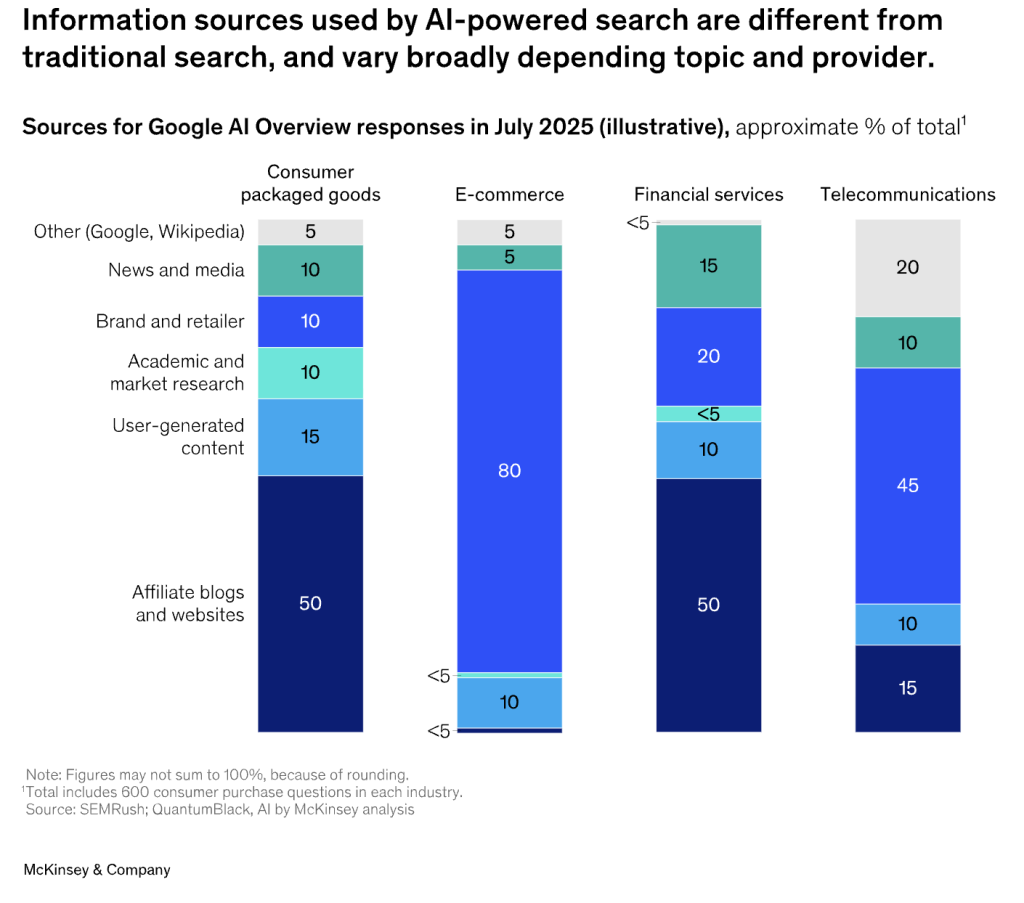
Source: McKinsey & Company
Core Differences Between GEO and SEO
The differences between GEO and SEO make more sense when you look at how each one decides what to surface. Traditional SEO is about ranking pages in the search results. GEO is about earning a place as a cited source in AI generated answers. The decision making behind both is very different.
A good way to look at it is in two parts:
How content is chosen
SEO relies on signals like links, relevance, crawlability and technical performance. GEO leans more on clarity, entity strength, topical depth and how well your content aligns with the way people phrase questions in AI tools. You’re not trying to win a ranking position. You’re trying to be trusted enough to be referenced.
How success is measured
This is where GEO breaks away from SEO. You’re not only tracking clicks or impressions. GEO is about visibility, mentions, being pulled into summaries and becoming a recognised source within a topic. It’s closer to authority building than it is to traffic chasing.
What Is SEO?
Search engine optimisation is about improving your site so it ranks higher on Google or Bing. At its core, it comes down to a few areas:
- Keyword research
Understanding what people search for and shaping your content around it. - Backlinks
Earning links from credible sites to show you have authority. - Technical work
Making sure the site loads quickly, is mobile-friendly, and is easy for search engines to crawl. - User behaviour signals
Click through rate still plays a part even if Google pushed back on it for years.
When you get these elements right, your site fits neatly into how search engines judge relevance and quality. That is what moves you up the results.
What Is GEO?
Generative engine optimisation is about being cited in AI answers rather than fighting for a ranking position. The goal is to help ChatGPT, Perplexity, Gemini and Claude see your content as a reliable source they can pull from.
Structure matters a lot more here. Clear headings, lists, and direct language make it easier for AI to understand what you are saying and lift the right information.
Where SEO is about improving your position in the results, GEO is about becoming the reference point the answer is built from.
Process
With SEO, search engines use a three-step process: crawling, indexing, and ranking.
Before your website content becomes discoverable to users, bots must first crawl, process, and index your web page in their database. Search engines then use their ranking factors (like the user experience of your website, content depth and quality, and backlinks) to display and rank web pages that match the search query.
GEO, on the other hand, places a lot more emphasis on content. AI platforms continuously consume content and use relevancy and reliability to decide which sources to use when creating AI-generated answers. If your content presents clear statements in a structured way and showcases your authority in the field, you increase your chances of getting cited.
As the influence of AI on search grows, many established SEO approaches are evolving to meet new user behaviours and AI-driven ranking, a shift that is changing 2025 strategy for search and can be seen in discussions on how AI is impacting SEO today.
Metrics
The success of an SEO strategy is typically evaluated by tracking click-through rates (CTRs), bounce rate, and the number & position of keyword rankings.
However, non branded queries are already seeing close to a 20% decline in CTR, signalling how AI driven search is reshaping SEO strategy in 2025, as highlighted in this AI search strategy analysis by Blaze Media.
To measure the success of your GEO efforts, you’ll need to look at how often AI-generated responses cite your content or include your brand in their responses.
Similarities Between GEO and SEO
While there are noticeable differences between these two strategies, they overlap in some ways. Hence, why some marketers argue that they’re actually the same.
Whether you want to improve SEO or GEO, you’ll need to prioritise content creation. You need high-quality content that matches user intent to show up in the search results of traditional as well as AI-powered search engines.
To a certain extent, AI-driven search builds on Google’s E-E-A-T concept, which uses experience, expertise, authoritativeness, and trustworthiness to rate content. If you can establish content credibility, you’ll get noticed by both Google and ChatGPT.
Both AI and traditional search engines also value the same type of structure. Clear headings that follow logically upon one another, short paragraphs, and bullet points make it easier to find the value in your content.
4 GEO Strategies
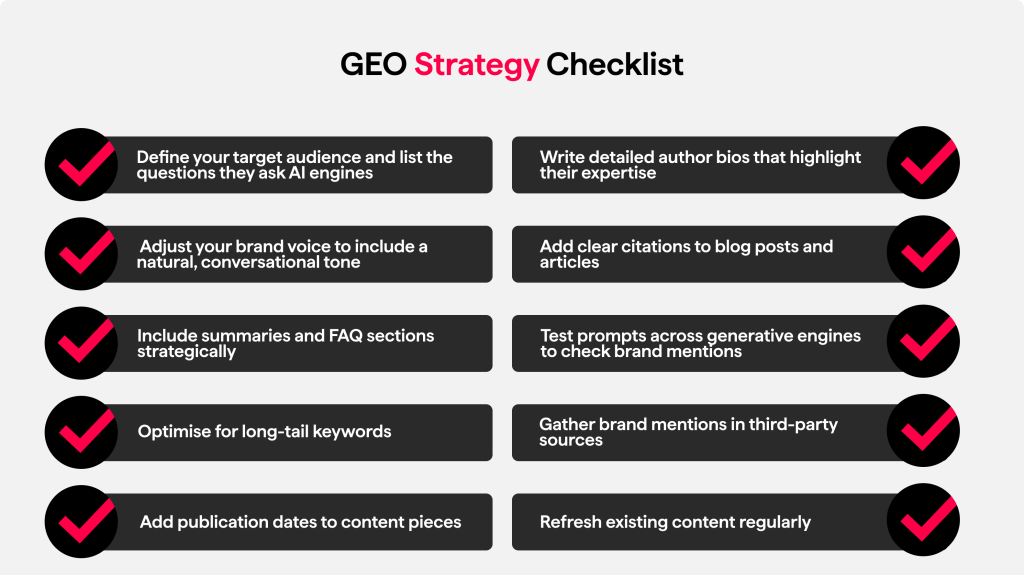
If you’re looking at GEO for the first time, it can feel a bit abstract. To make it clearer, I’ve pulled together the core strategies that actually move the needle. These are the practical steps that help AI engines understand who you are, what you offer, and why you’re a credible source. The checklist below breaks them down in a way that’s easy to follow.
Scrutinise structure
Whether you’re writing a landing page, product descriptions, or articles for blogs, ensure that you use a clear heading structure. This means using a mix of descriptive H1s, followed by relevant H2s, H3s, H4s, etc.
Another way that you can help AI models to pull facts is to add bulleted lists. For example, long paragraphs that describe processes can be rewritten as a list of actions, or at least shorter sentences.
Summaries of key takeaways and frequently asked questions (FAQs) also make it easier for AI to extract data.
Write for long-tail queries
There’s another reason why your GEO strategy should focus less on keywords. Consumers use traditional search and AI answer engines differently. With Google, search queries are shorter. On the other hand, when they interact with ChatGPT, they use longer prompts that use more descriptive words and conversational language.
Keyword research tools can help identify long-tail keywords. But to identify the types of questions being asked, you can turn to online forums like Reddit, Quora, and even TikTok.
Next time when you doomscroll in the name of research, ask yourself:
- Which topics are trending?
- Which types of questions are users asking?
- How are they phrasing their questions?
Analysing Reddit threads will help you create content that answers actual search queries.
Add sources for claims
Content with clear citations appears higher in AI summaries. Where possible, add a link to a source to add validity to your statements. In fact, Search Engine Land suggests a minimum of one data point per key section. You can, for example, link to case studies, survey results, benchmark reports, or statistics.
In addition to concrete numbers, you can also incorporate qualitative data. Quotes from an authoritative voice can act as a credible reference and add more context to a statistic.
Refresh content regularly
GEO is as much as it is about creating new content as it is about refreshing existing content. As mentioned earlier, AI models give preference to up-to-date content.
To ensure your content remains accurate, you can include historical optimisation as part of your content strategy. It’s not a new concept and SEO teams have been doing it for years. Search Engine Land recommends that you audit your content each quarter by:
- Checking that statements are still factually correct
- Ensuring that you cite reputable sources
- Replacing old statistics with recent data
- Checking that sections follow a clear structure
Is SEO Still Important in 2026?
Even though people can now also ask ChatGPT for anything from how-to guides to hotel recommendations, traditional search engines aren’t being replaced by ChatGPT. In fact, AI search generates less than 1% of referral traffic.
As such, you still need to use marketing strategies, like SEO, to ensure you show up in the search engine results pages.
Organisations also realise this. The majority (56.6%) remain confident in SEO’s relevance and aren’t reducing their SEO investment, according to Search Engine Journal’s State of SEO 2026 report. What’s more, 65% don’t expect their SEO budgets to decrease in the next 12 months.
Combined Approach: Integrating GEO and SEO
You can think of GEO a bit like how new social platforms appear. Every so often something new launches and it becomes another place to reach people. You don’t ditch what already works. You adapt so you can show up in both spaces.
Take Threads as an example. Brands didn’t shut down their Instagram accounts. They adjusted their content to work on both platforms. GEO and SEO should follow the same idea.
How the two fit together
• Most of your content was originally written for SEO. That’s fine. Going forward, you can focus on adding more authority signals and clearer structure.
• Use checklists, tables and FAQ blocks. They help AI engines interpret your content and they make life easier for users.
• Audit your existing content. This is something you should already be doing for SEO anyway.
• Start with your best performing pages and look for simple improvements.
Quick structural improvements
• Add more headings to break up heavy paragraphs.
• Where it makes sense, turn subheadings into questions. For example, instead of “Integrating GEO and SEO”, use “How can you integrate GEO and SEO strategies?”
• Add quotes, stats or external references to strengthen authority.
• If you already have data points, see if you can replace them with a more recent stat.
What success looks like
GEO changes how you measure performance. If your click through rates drop but you’re being cited more often by AI tools, that is still a win. It means your authority is growing even if the traffic shifts.
Get A Free SEO Check
Identify technical and on-page gaps affecting your search visibility.
Get Your Free SEO CheckFAQ's
What is the difference between SEO and GEO?
SEO uses keywords, internal linking and backlinks, and technical performance to rank higher in the search results of traditional search engines like Google, Bing, or Yahoo. GEO focuses on creating accurate, well-structured content that generative AI engines can easily reference or recommend.
Did this answer your question? YesThat’s great glad we could help! Start a ProjectNoNo problem, one of our experts can give you a more in-depth answer. Ask our ExpertsIs GEO the same as AEO?
GEO stands for generative engine optimization, while AEO is short for answer engine optimization. Essentially, they mean the same thing. That said, there are subtle differences with AEO more focused on optimising your content for direct answers. GEO is described as the next evolution, and its goal is to get your brand referenced by generative AI systems and not just snippets.
Which common mistakes should you avoid with GEO?
Examples of early mistakes that brands typically make when implementing generative engine optimization are:
- Prioritising keywords over factual content that can be verified
- Sharing unstructured or disorganised data
- Failing to gather brand mentions and build their online presence on other reputable websites like review platforms
- Not updating content with new trends, stats, or examples
Does GEO replace traditional SEO or should they be done together?
GEO is not a replacement for SEO. AI search still contributes less than one percent of referral traffic, so organic search remains essential. You need both. GEO helps you get cited in AI summaries and answer boxes. SEO helps you retain your organic rankings for commercial search terms. When you align both strategies, you cover how users search and how AI systems answer queries.
Did this answer your question? YesThat’s great glad we could help! Start a ProjectNoNo problem, one of our experts can give you a more in-depth answer. Ask our ExpertsHow do AI engines decide which content to cite in their responses?
AI models look for clear, factual, and well-structured content. They prefer pages that use clean headings, short paragraphs, lists, up-to-date statistics, and statements that can be pulled out as standalone facts. They also look for signals of authority, including author bios, citations to reputable sources, and mentions of your brand across external websites. If your content shows expertise and is easy to extract, it is more likely to be referenced.
What types of content tend to perform well with generative engines?
Content that gives direct answers to specific questions, explains processes step by step, or provides structured guidance performs very well with GEO. Checklists, FAQ pages, tutorials, case studies, industry statistics, and updated benchmark data work particularly well. AI engines struggle with vague content. The clearer and more organised your page is, the easier it is for a model to reuse the information and credit you.
How do I measure the success of a GEO strategy?
You measure GEO performance differently from SEO. Instead of focusing only on impressions, clicks, or rankings, you look at how often AI tools reference your brand or use your content in their answers. This includes citation rates, brand visibility in AI responses, and how often your pages are surfaced during prompt testing. You should also monitor engagement metrics, because clearer and better structured content usually improves user behaviour signals at the same time.
Did this answer your question? YesThat’s great glad we could help! Start a ProjectNoNo problem, one of our experts can give you a more in-depth answer. Ask our ExpertsWhich optimisation mistakes tend to hold GEO performance back?
The biggest mistakes include keeping outdated statistics on the page, failing to provide citations for important claims, and relying on keyword stuffing instead of answering questions directly. Long paragraphs with no headings make extraction harder. Another issue is leaving old content untouched for years, because generative engines heavily favour recent or refreshed information. Many brands also ignore building mentions on reputable third party sites, even though it reinforces trust signals for AI models.