How to Rank on ChatGPT and Bing Copilot in 2026 [Full Guide]


Search is no longer confined to blue links. ChatGPT Search now handles more than a billion queries each week, reshaping how people discover brands and services (Reuters). For UK marketers and business owners, that means visibility now depends on how clearly your content can be read, cited, and trusted by AI assistants, not simply ranked by Google.
This guide explains how to rank on ChatGPT through practical AI search engine optimisation steps that make your site extractable, verifiable, and consistently referenced. By the end, you’ll know exactly how to structure pages, monitor performance, and work with our AI search and GEO optimisation experts to stay visible wherever your audience is asking questions.
How to Rank on ChatGPT (Core Principles)
To rank on ChatGPT, think less about keywords and more about signals of selection. AI assistants choose which content to cite based on how clearly it answers a question, how trustworthy it appears, and how easy it is to extract. In Microsoft’s words, AI search is “selection, not discovery.”
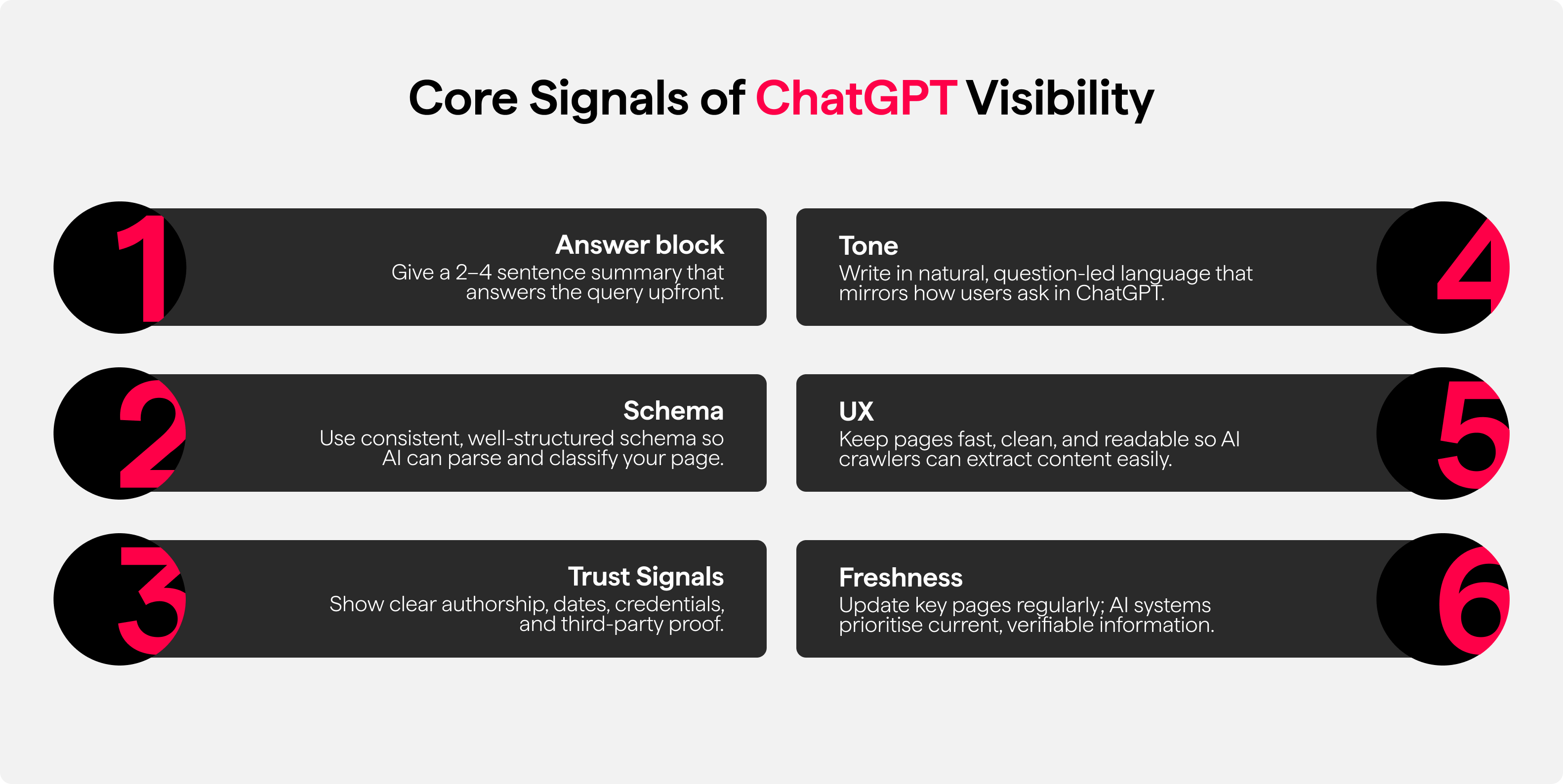
Here’s what matters most:
1. Clear, Answer-Ready Structure
AI systems prefer sections that resolve a question quickly. OpenAI notes that ChatGPT fetches and cites web pages that are crawlable, concise, and contain short factual summaries near the top.
- Do this today: Add a 2–4-sentence answer block at the start of your best-performing pages.
2. Structured Content and Schema
Schema markup tells an AI what your page contains: organisation, article type, author, or product details. Google confirms that structured data improves eligibility for AI features.
- Do this today: Use FAQPage and Article schema plus consistent @id references for every major entity.
3. Authority and Trust Signals
AI models connect consistent brand mentions with author credibility. Verified reviews, visible credentials, and a clear ‘last updated’ date all reinforce authority and experience.
- Do this today: Ensure your brand name and author bio appear in the same phrasing across press releases, guest posts, and site copy.
4. Conversational Queries and Tone
Research from Nielsen Norman Group shows that AI users phrase questions naturally and expect immediate, human-sounding explanations.
- Do this today: Rework key headings into question-led H2s that mirror how people ask in ChatGPT; for example, “How does structured data improve visibility?”
5. User Experience and Clarity
Maintain a clear, mobile-ready layout and fast load speeds; assistants ignore sites that delay or hide key text. Slow or cluttered pages are often skipped during crawl.
- Do this today: Audit performance and ensure pages load in under two seconds.
These principles form the backbone of ChatGPT’s visibility. Build each one into your workflow; structure for clarity, speak conversationally, show proof of expertise, and treat every page as if it could be quoted verbatim in an AI-generated answer.
Technical Setup for AI Search (ChatGPT and Copilot)
AI platforms rely on technical clarity as much as content quality. If your site blocks the right crawlers, hides information behind scripts, or loads too slowly, it won’t appear in ChatGPT or Copilot answers, no matter how good your writing is. Think of this setup as your foundation for visibility.
1. Open Up the Right Bots
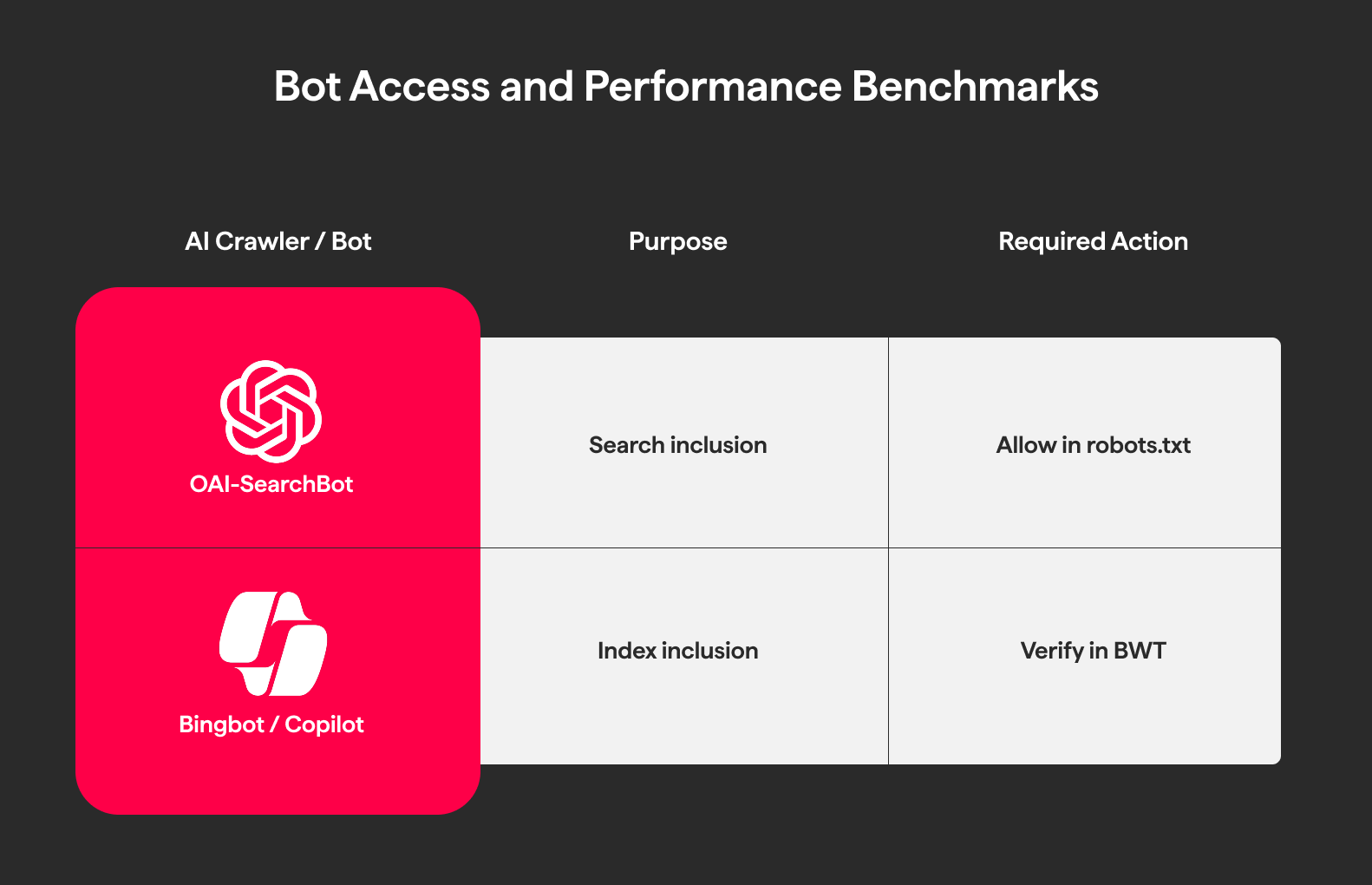
ChatGPT relies on two crawlers: OAI-SearchBot for search and GPTBot for training. To appear in answers, you must allow the first one. OpenAI’s Publishers FAQ advises checking your robots.txt file for a clear allowlist.
Monitor visits from “ChatGPT-User” in your analytics; these signal real assistant-driven queries reaching your pages.
2. Keep Pages Fast and Accessible
Cloudflare’s analysis of modern AI crawlers shows that performance and accessibility affect selection. Keep JavaScript content crawlable, maintain responsive layouts, and aim for LCP under 2.5 seconds with a stable TTFB below 800 ms.
3. Verify Visibility in Bing Webmaster Tools and IndexNow
Copilot pulls from Bing’s index, so verify your site in Bing Webmaster Tools, upload fresh sitemaps, and enable IndexNow for instant content updates.
- Expert Tip: Verify property in BWT, submit sitemaps, and activate IndexNow before making large-scale edits or launches. It shortens inclusion time significantly.
4. Align with Google Search Console Parity and Schema Consistency
Maintain parallel setup in Google Search Console to track crawling and AI-related impressions. Ensure markup stays consistent across pages using matching @id references for major entities.
Once these baselines are met, your content becomes accessible, traceable, and fast enough to be cited by AI engines; the technical groundwork every team should put in place before scaling AI search optimisation.
How Do ChatGPT and Bing Copilot Rank and Cite?
When someone asks a question in ChatGPT or Bing Copilot, the engine doesn’t “rank” pages in the old sense. It selects small, relevant sections from multiple sites that can be cited to build a clear, factual answer. That’s the new visibility contest; being the source an AI trusts enough to quote.
How ChatGPT Selects Sources
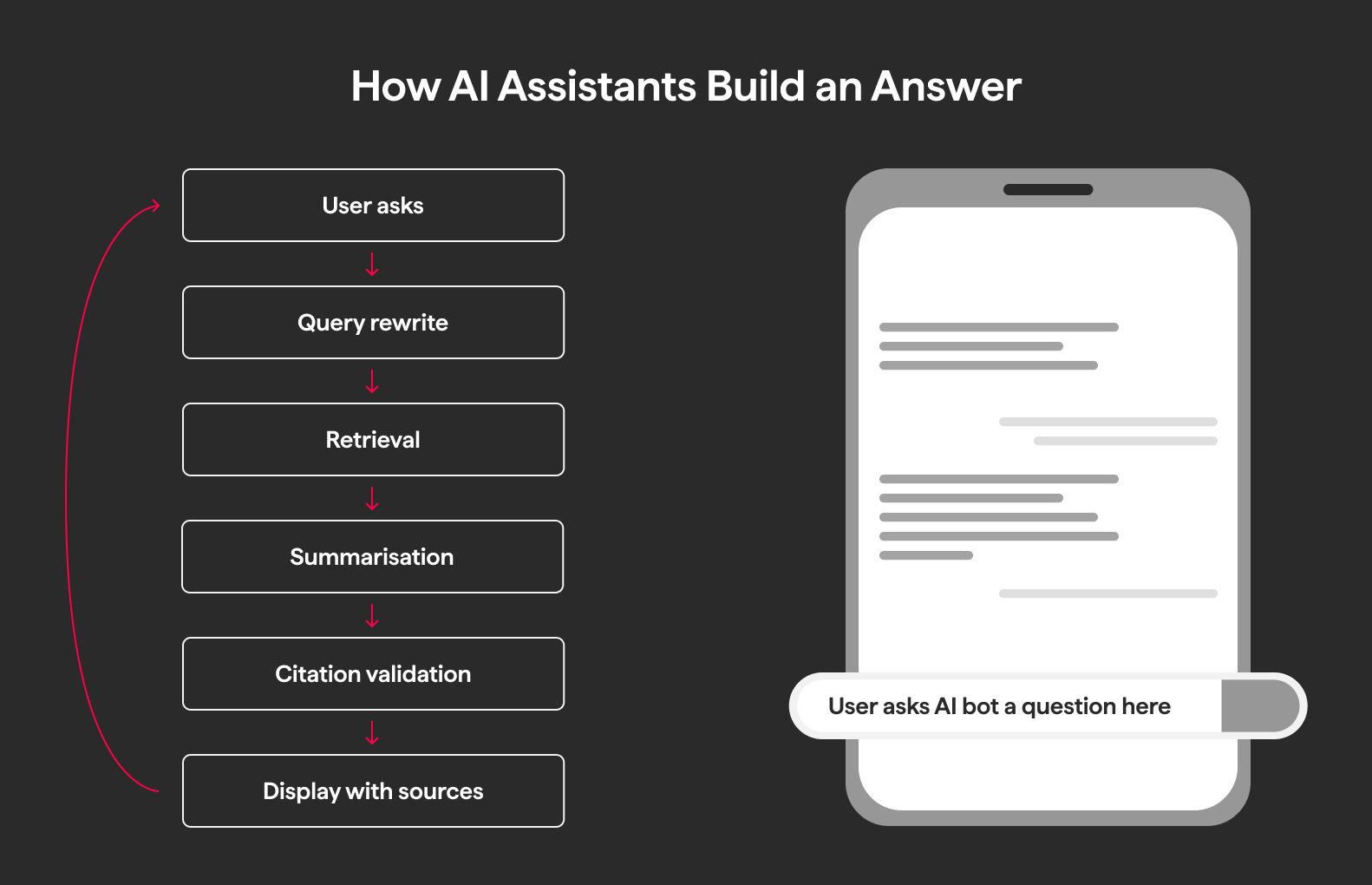
ChatGPT Search uses a real-time retrieval system, not a static index. When a user types a query (say, “how to improve site visibility in AI search”), the engine rewrites that query for precision, fetches results from trusted public websites, and checks whether the text can be cited directly. It then builds a response that includes traceable attributions. Pages that are crawlable, structured, and regularly updated are favoured because they’re easier to parse and reference.
How Copilot Composes Answers
Bing Copilot works through a retrieval-augmented generation (RAG) pipeline:
- It rewrites the question using context from the conversation
- It retrieves matching results from Bing’s index
- It summarises the findings while validating citations
Microsoft stresses traceability; the assistant must be able to show where each statement originated. If your page includes structured headings, verified authorship, and clear metadata, it’s easier for Copilot to attribute and display.
Why Freshness and Volatility Matter
AI surfaces change fast. Ahrefs found that AI-generated summaries on Google refresh roughly every two days, with nearly half of cited URLs replaced in each cycle. Similar volatility applies to ChatGPT and Copilot, so keeping content fresh is essential.
In short: user asks → AI rewrites → retrieves → filters for clarity and credibility → cites the cleanest match. The better your structure and sourcing, the higher your chances of appearing in those search results in Copilot and ChatGPT answer panes.
How To Build Topical Authority (GEO in Action)
Generative Engine Optimisation (GEO) is the discipline of building content that AI systems can understand, connect, and quote without confusion. Where traditional SEO stops at ranking, GEO focuses on recognition, ensuring your brand, entities, and expertise show up consistently across the web’s conversational layer.
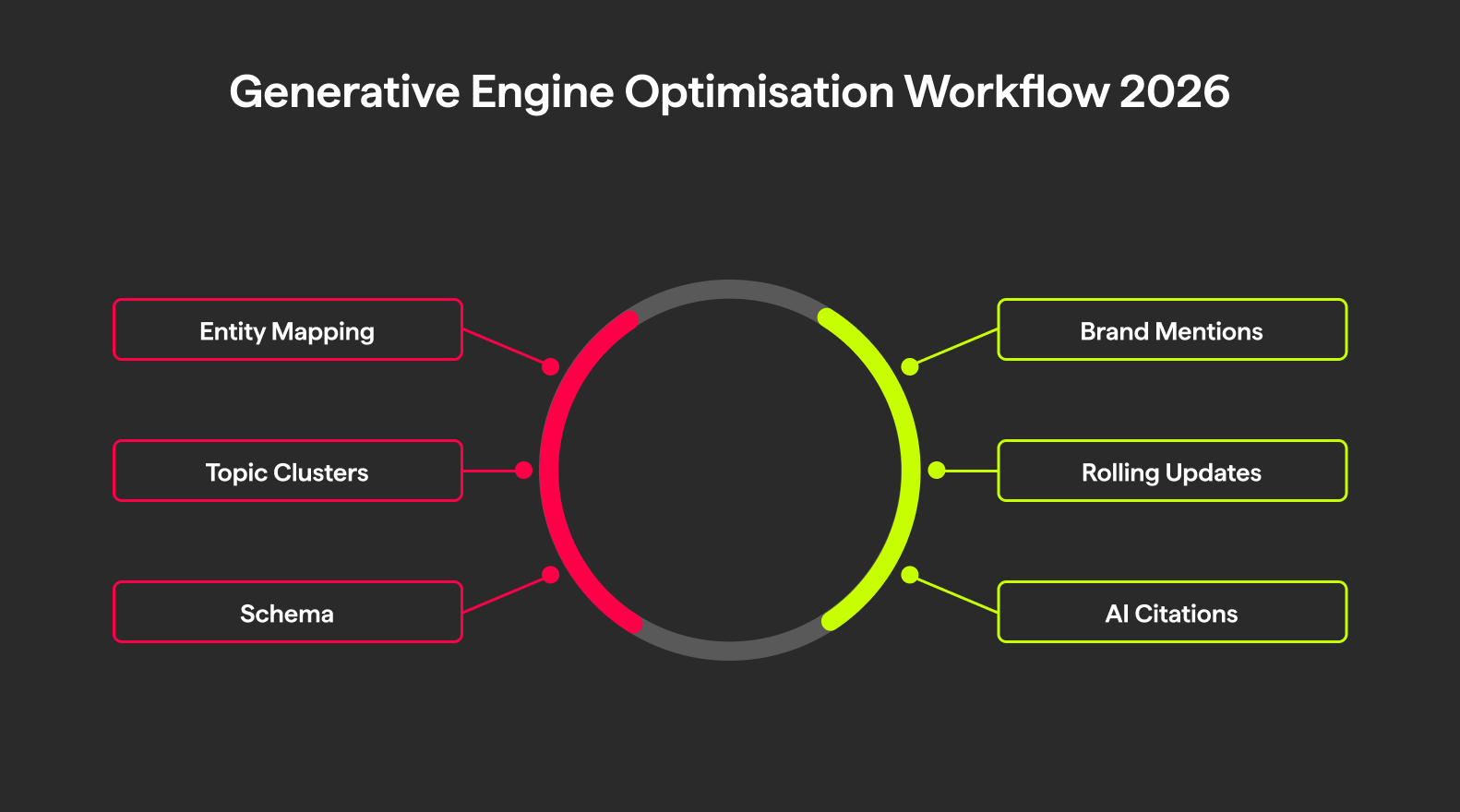
GEO, a term from Princeton-led research published in 2024, works by aligning pages around well-defined entities (people, products, industries) and structuring them so that AI crawlers can identify relationships between topics. When these links are clear, the model treats your content as an authority within that subject space rather than just another result.
The practical side of GEO:
- Cluster your topics: Build content groups around a central theme (for instance, “AI search optimisation”) and interlink them logically.
- Map entities: Name people, tools, and sectors consistently. Use schema and @id tags so they’re machine-readable.
- Repeat brand mentions naturally: Consistency builds brand visibility and trust in AI selection models.
Public guidance points the same way. Structure your pages so key information sits in predictable places. This consistency helps AI engines parse meaning across your cluster.
Microsoft highlights selection signals and clear attribution paths; OpenAI requires crawlability plus answer-ready blocks and exposes ChatGPT referrals in analytics. Ahrefs shows AI summaries reshuffling sources frequently. Together, that supports a GEO workflow focused on structured content, schema consistency, and a rolling update cadence.
Backlinko’s GEO playbook echoes this: clarity, schema, and relevance win visibility. Treat every page like a node in a knowledge graph, not a standalone article. That’s how you build topical authority in an AI-first search world.
Boost your ChatGPT & Copilot visibility
Explore our GEO and AI search optimisation services to improve how your site is found in AI search.
Boost Your AI RankingsAI Search Optimisation Tools and Techniques
Choosing the right stack of AI search optimisation tools makes the difference between guesswork and measurable progress. Each has a defined role in helping your team plan, structure, and monitor visibility across AI-driven platforms.
Content scoring and optimisation
- MarketMuse, Clearscope, and Frase help identify information gaps and measure how well a page aligns with real search intent.
- Use this when: reviewing existing articles to ensure each section directly answers a user’s question rather than repeating keywords.
Entity and schema tools
- Use InLinks or a schema generator to keep entity relationships machine-readable.
- Use this when: you need a clean, machine-readable way to show AI crawlers what connects your products, people, and topics.
Tracking and analytics
- GA4 and Google Search Console remain the baseline for measuring human traffic, impressions, and crawl status.
- Ahrefs’ AI Visibility Audit adds a newer layer, tracking how often your pages appear in generative answers or AI snippets.
- Use this when: you want to compare traditional metrics with assistant-driven citations to see if your updates are paying off.
Monitoring and verification
- Perplexity Alerts notify you when your brand or URL appears in AI answers, helping track citations in near real time.
- Originality.ai serves a different purpose: verifying that your own published text remains human-authored and compliant with platform standards.
- Use this when: auditing internal or outsourced content before publishing.
Crawl and freshness management
- Use Bing Webmaster Tools to confirm crawl status and push key updates.
- Use this when: you’ve made structural or content updates and want them reflected in Bing and Copilot results without waiting for natural recrawls.
Together, these tools keep your workflow balanced; creative in planning, structured in execution, and verifiable in results.
2026 Trends Shaping AI Search
The year ahead will test how fast marketers can adapt to an AI-first search economy. Four forces are already reshaping the field:
- AI-native analytics replace traditional SERP tracking. Dashboards are moving beyond keyword ranks to measure assistant mentions, citation rates, and conversational reach. Marketers must learn to read AI visibility the way they once read Google positions.
- Voice and multimodal search converge. Assistants now answer through text, speech, and visual prompts. Content must describe, show, and explain; optimised for how people talk and what they see on screen.
- Cross-engine entity graphs emerge. Google, Bing, and OpenAI are syncing shared entity data. Authority will depend on how consistently your brand appears across ecosystems, not just one index.
- Regulation demands transparency. The EU AI Act and UK guidelines require explainable sourcing. Visible authorship, dates, and evidence are no longer optional; they’re compliance signals as well as trust signals.
Conclusion: How to Rank on ChatGPT and Copilot
AI search has changed the rules. Success no longer depends on keywords but on how clearly your content defines entities, shows structure, and earns trust. Microsoft and Google both emphasise the same thing: assistants select what they can understand and verify.
If you want your brand cited by AI systems rather than buried behind them, start refining structure today; auditing schema, authorship, and clarity. For expert guidance, explore our AI search optimisation services or speak with our SEO team to make your content ready for the next generation of search.
FAQ
What is Generative Engine Optimisation (GEO)?
Generative Engine Optimisation is the process of structuring and linking your content so AI systems can interpret and cite it accurately. GEO, a term from Princeton-led research published in 2024, treats every page as part of a connected entity graph rather than an isolated keyword target. Start by mapping key entities, using schema, and maintaining consistent phrasing across your site.
Did this answer your question? YesThat’s great glad we could help! Start a ProjectNoNo problem, one of our experts can give you a more in-depth answer. Ask our ExpertsHow do AI Overviews work?
Google’s AI Overviews summarise web results using machine learning to extract the most relevant and verifiable facts. The system prioritises structured, people-first content with clear context and sources. Add concise, factual paragraphs and proper schema markup to increase inclusion eligibility.
Did this answer your question? YesThat’s great glad we could help! Start a ProjectNoNo problem, one of our experts can give you a more in-depth answer. Ask our ExpertsDoes ChatGPT content rank on Google?
No. ChatGPT’s answers aren’t indexed; only the original pages it cites can appear in Google search. Visibility depends on whether your site is structured, crawlable, and clearly attributed so ChatGPT links back. Focus on earning ChatGPT citations that direct users to your verified page.
Did this answer your question? YesThat’s great glad we could help! Start a ProjectNoNo problem, one of our experts can give you a more in-depth answer. Ask our ExpertsHow to optimise for Perplexity AI?
Perplexity surfaces quick, sourced summaries drawn from public web pages. Ensure your site allows AI crawlers like OAI-SearchBot and GPTBot, use concise headings, and include author names and publish dates. To boost visibility, mirror answer-engine principles: clarity, traceable facts, and consistent updates.
Did this answer your question? YesThat’s great glad we could help! Start a ProjectNoNo problem, one of our experts can give you a more in-depth answer. Ask our Experts